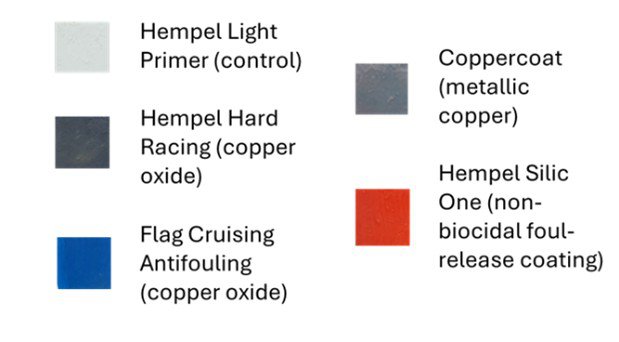
Antifouling panels at Brightlingsea were submerged on 17 March 2025 and removed on 19 November 2025. After eight months in the water across the boating season, data was collected to investigate the efficiency of various antifouling coatings. Based on local survey results, the coatings tested were:
- Hempel Hard Racing (Biocidal)
- Flag Cruising Antifouling (Biocidal)
- Coppercoat (Biocidal)
- Hempel Silic One (Non-biocidal)
- Hempel Light Primer (Non-biocidal control)
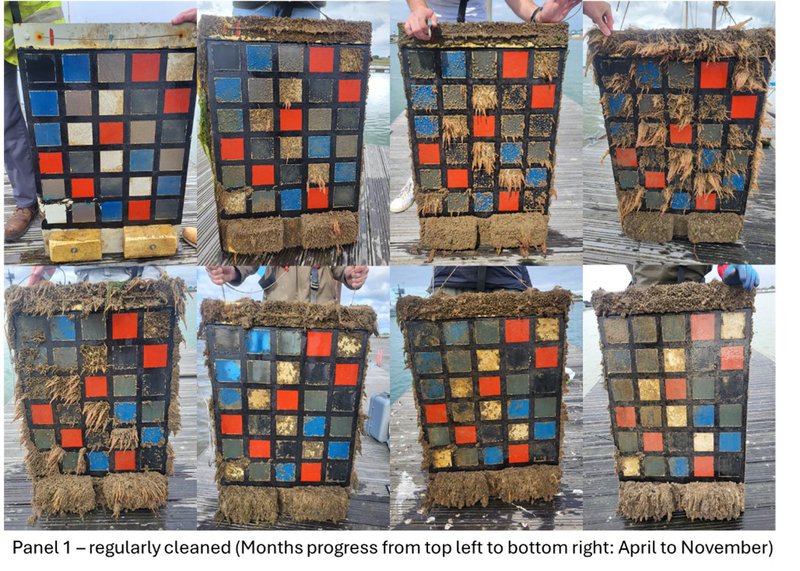
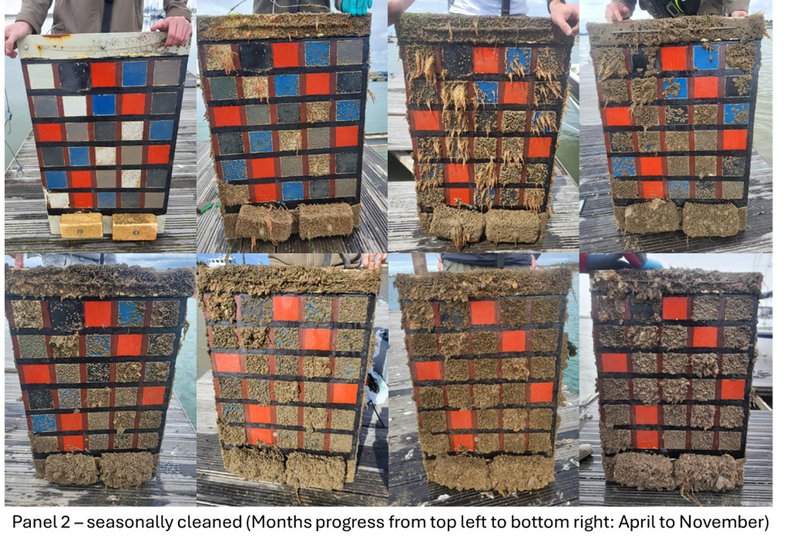
Below are images from two treatment panels: Panel 1, regularly cleaned with macrofouling removed after analysis each month, and Panel 2, seasonally cleaned, with macrofouling removed at the end of the boating season. This data is from the first season only, so Panel 2 has not yet been cleaned.
Across the full season, the Mottled Tubemaker (Jassa falcata) was the earliest and most abundant macrofouling coloniser. It forms sediment-based tubes that allow it to settle on biocidal coatings, creating a foundation for further fouling, including the Organ Pipe Hydroid (Ectopleura larynx), which can significantly increase biomass.
Fouling on Hempel Silic One was consistently low across both panels, with virtually no macrofouling settlement throughout the season. However, all biocidal coatings developed macrofouling within two months of submergence. There were also clear differences between the cleaning regimes: on regularly cleaned panels, overall macrofouling declined after August, with the mottled tube maker not recolonising in large abundances and the Organ Pipe Hydroid disappearing. In contrast, seasonally cleaned panels accumulated dense fouling that persisted even after the Organ Pipe Hydroid dieback.
Percentage coverage of fouling is being calculated using a trained machine learning model, creating an objective dataset that is rarely available for recreational coatings. Results will be published in the future, so keep an eye on the blog if you are interested in this or any upcoming antifouling research. And please feel free to contact me at jacob.cook@essex.ac.uk with any questions.